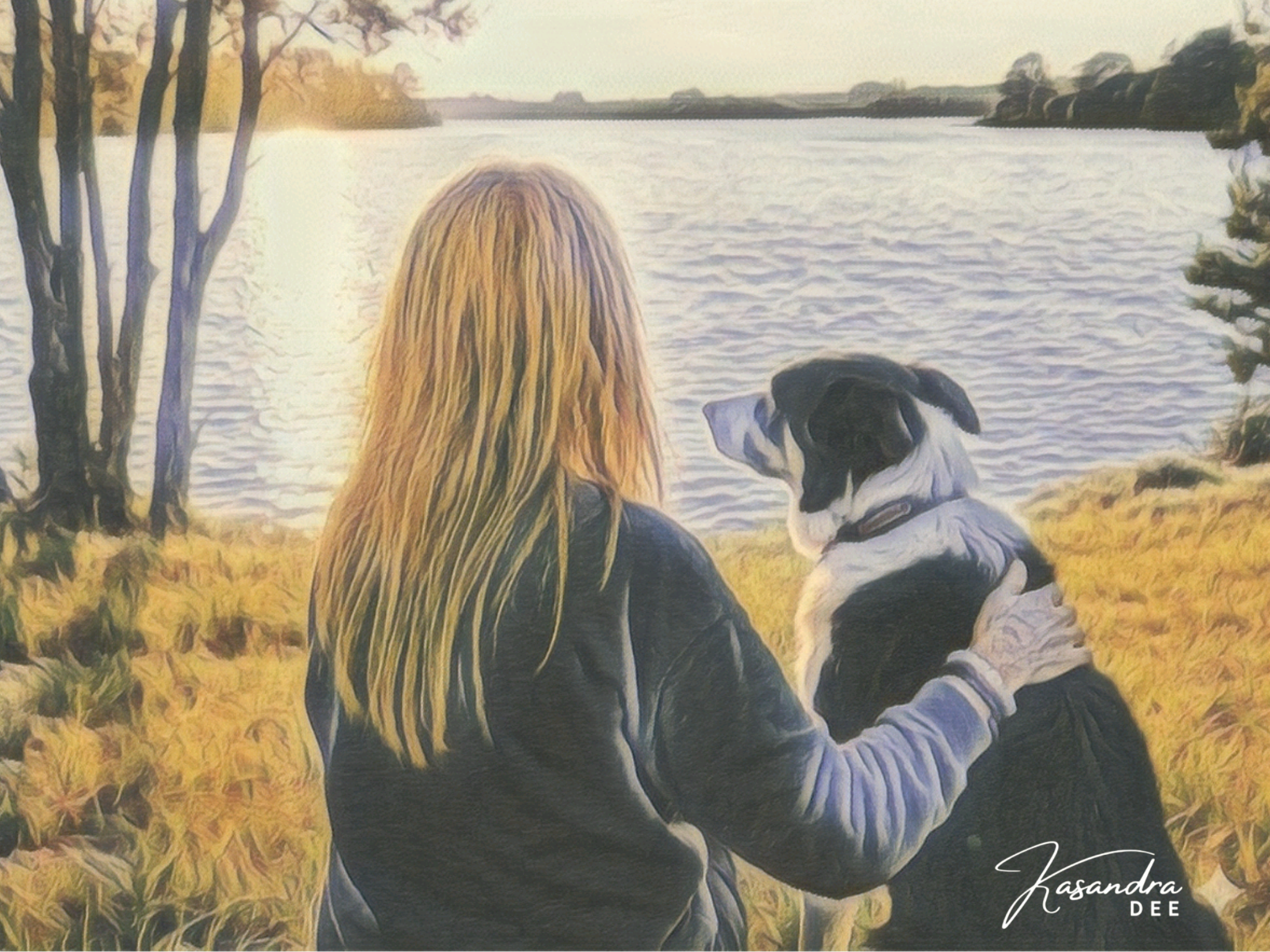
The Dog That Taught Me About Trauma, Healing and Safety
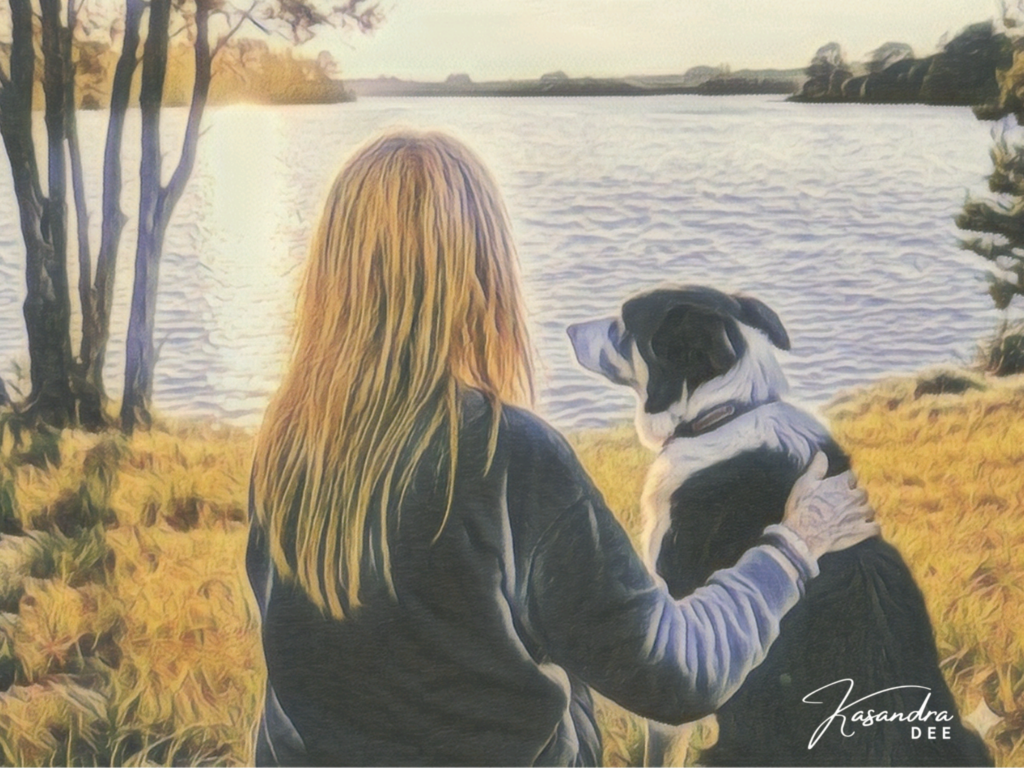
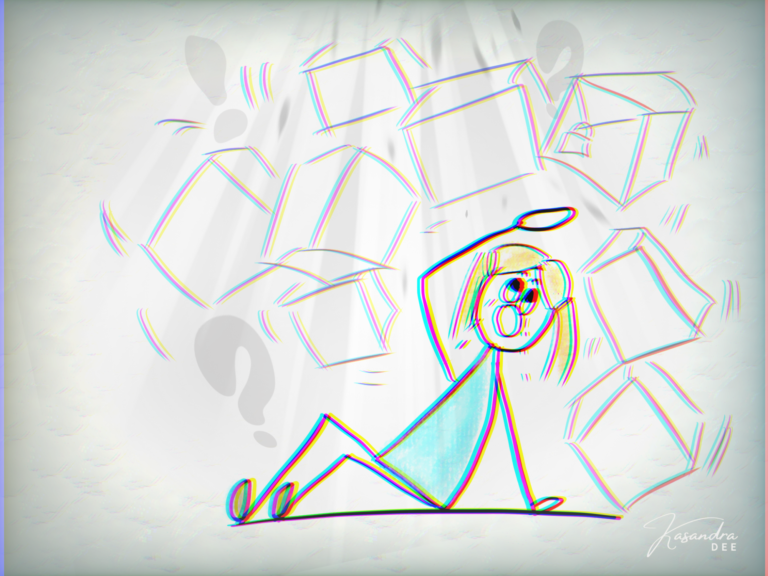
*Self-portrait by KS, reworked digitally
I don’t know exactly what I believe about the spiritual world. I lean towards fairly practical explanations for most things. I believe we share energy with each other while we’re alive, but when it comes to what happens after death, my views probably sit closer to atheism.
And yet, I have a soft spot for psychics. Most of what they’ve told me over the years hasn’t come true. But one prediction in particular stayed with me.
Two different psychics, only weeks apart, told me there was a black and white shepherding type dog around my husband and I. At the time, I had no idea who this dog was.
A year later, she arrived. What I didn’t realise at the time was that this little dog would teach me more about trauma, healing, and compassion than I could ever have expected.
The Prediction
The two psychics both mentioned a black and white collie type dog with a healing energy, being around us.
Despite having no idea of the healing journey ahead of me, I remember feeling intrigued by this dog who might be coming into our lives.
When sharing the psychic’s readings with my husband he reminded me he’d been considering adopting a neighbour’s working dog – a sheep dog. When I asked what she looked like, he said she was black and white.
I replied, “I think we might be getting her”.
Meeting Tinkerbell
Fast forward to mid 2025. I had been doing the hard work of healing for a few months when it was time to adopt our new black and white family member.
With her petite facial features and immediately obvious loyal nature, I renamed her “Tinkerbell”.
Everyone who meets Tinkerbell can’t help but call her ‘sweetheart’. She’s soft, gentle and soulful.
But there was something else in her eyes. They followed our every movement. They never seemed to soften or rest, even if her body appeared more relaxed.
Of course, she had every reason to be unsettled. She was managing the stress of changing environments, leaving what was familiar and suddenly adapting to a completely different lifestyle. For the first time she had a bed inside a house, she was invited to spend her days indoors, went on car rides, and her days were no longer centred around work.
But what we were seeing was more than uncertainty. Most dogs would eventually move from caution to curiosity. Tinkerbell didn’t seemed to. Instead, she remained watchful, as though she was waiting for something to happen.
The Language of Fear
We knew Tinkerbell would settle as trust built. What we didn’t expect was how long that would take.
Within the first week, it became clear that something deeper was going on. She withdrew from some attempts to pat her. If she was resting and someone stepped over her, she jumped to her feet. She flinched at raised voices. If we threw a stick, even in the opposite direction, she ran back to the house. And if we tapped her to stop her eating something she shouldn’t, she yelped as though she expected far more than a gentle correction.
What made it even more striking was that we knew she had spent many years with responsible owners who cared for her well. Whatever had shaped these responses had come from earlier in her life. We can never know exactly what happened to her as a young dog, but it was clear that she’d experienced something that left an imprint on her.
The more I watched her, the more she taught me. Her hypervigilance, flinching and startle responses weren’t character flaws. Her body was remembering what it once needed to in order to survive.
And it was reacting to that old script, long after the danger had passed.
The Moment That Broke My Heart
I have written before about how disconnected I have been from my own emotions. Tinkerbell provided me with an early opportunity to allow emotions to rise and flow through me.
Our two dogs were running around playing outside and Tinkerbell was knocked into the pole of the washing line, her little body wrapping around it. She yelped with the pain and limped over to me for comfort.
I was devastated. I was scared that she was hurt, but underneath that was crushing guilt. I knew the bigger dog could be boisterous and I hadn’t managed that. I also felt guilty that she had directly sought out my company for comfort, when I was the one who hadn’t managed the situation well in the first place.
But I also recognised immediately that my reaction wasn’t only about her. It touched a raw nerve in me.
I felt sad at how easily a gentler being could be harmed by something more forceful and unaware. I was upset with myself for not listening to my intuition. The guilt became an echo of what I was already carrying regarding my own life. And, I saw the parallel – just as Tinkerbell had run straight to me for comfort, I realised how often I too had instinctively sought comfort from people who were unable to safely give it to me.
I took Tinkerbell for a walk mostly to calm myself down and as soon as I was alone, the tears flowed and I apologised to her, over and over.
What Tinkerbell Taught Me About Trauma
1. Triggers are automatic bodily responses
Both Tinkerbell and I have early experiences that shaped how our bodies respond to the world.
In her, it shows up as hyper-reactivity and scanning the environment for threat. She sees a stick being raised and she runs without watching for what direction it is heading in.
In me, it shows up in my body – tightness, sudden activation, or the urge to shutdown before I’ve even consciously registered why. Emotional reactions can appear suddenly and fully formed, often before I’ve had any opportunity to think my way through what’s happened. Sometimes in these moments, my legs can’t hold me and I drop to the floor. Something has been activated without warning.
We are not choosing these responses. They happen faster than thought, and can easily be misread as overreactions when in reality they are protective patterns shaped by our experiences.
I’m learning to respond to myself with the same compassion I give to Tinkerbell. Even when my body reacts as though I am still in danger, I can hold both truths – the reaction is real, and the present moment is different.
2. Safety takes repetition
We are both learning ease through repetition, not through single moments of reassurance.
For Tinkerbell, it is the accumulation of small and consistent experiences that teach her she’s safe. We’ve worked on gently approaching her, giving her space, and allowing her to choose when she is in contact with us. When once she would only sit on the other side of the room, now she will sit for short periods at my feet, occasionally even resting her head on my leg.
For me, it is the same. One moment of steadiness is not enough to overwrite old patterns. Instead I have worked on keeping people around me who consistently offer calm, steadiness, and emotional security. This is gradually allowing my nervous system to soften.
When either of us experiences stress, our old patterns can spike again, but the return to a regulated place is becoming more familiar, and more easily achieved each time.
3. The difference between personality and survival responses
When Tinkerbell first arrived, her behaviour could easily have been mistaken for personality – timid, cautious, and unsure of people. But over time it became clearer that these were not fixed traits.
I can see a similar pattern in myself. For much of my life, I described myself as organised, capable, a helper who could manage multiple things at once. During periods of healing, many of those traits seemed to disappear, which initially felt confusing and unsettling.
What I have come to learn is that both of us were adapting to our environments. As trust increased, different parts of us began to re-emerge. Tinkerbell now shows more ease, more curiosity, and more trust in closeness. She wags her tail when we enter the room and she chooses proximity more often.
I am also learning about which parts of me are returning naturally, and those that were never really “personality” in the first place.
4. Healing takes time and isn’t linear
Despite Tinkerbell’s obvious fears, our bond with her was slowly growing. Then we experienced a setback.
After a single night in boarding kennels, Tinkerbell came home noticeably different. She avoided our other dog, had lost confidence, withdrew more often, and seemed unsettled in a way we hadn’t seen before. We suspected an incident during play may have frightened or hurt her. Whatever happened, it appeared to reactivate old fears.
Healing had never been a straight line for me either. There have been times when I have felt more settled, only for something unexpected to reactivate older patterns. In those moments it can feel as though all the progress has disappeared, when in reality the nervous system is doing what it has always learnt to do – returning to familiar protection.
Neither of us had gone backwards.
For Tinkerbell, we slowed everything down again, giving her the space, choice and consistency she needed to trust her world again.
I am learning to offer myself much the same: patience rather than frustration, compassion rather than judgement, and the reminder that a setback is not the same as starting over.
The Lesson I Was Avoiding
Watching and tending to Tinkerbell has been strangely healing.
I have spent years judging my own triggers, my own fears, and my own nervous system responses. Having Tinkerbell in my life has taught me that I deserve the same understanding I give her.
When I look at her, I don’t see weakness. I see a living being learning that the old vulnerabilities of her earliest years no longer apply.
Maybe that’s why I feel such an affinity with her. Because we are both learning the same lesson. That healing doesn’t come from forcing ourselves to stop reacting. It comes from experiencing enough compassion, enough consistency, and enough gentle experiences that one day our bodies know we don’t need to react.
A Name that Didn’t Quite Fit
There was one more thing that changed as Tinkerbell settled into her new life.
The name Tinkerbell suited the dog I imagined she was when she first arrived: tiny, delicate, and quietly enchanting.
But trauma has a way of hiding parts of us; when we are surviving, we become who we need to be rather than who we truly are. As her confidence grew, we didn’t witness the creation of a new identity, but the gradual emergence of the dog she had always been.
So eventually, we stopped calling her Tinkerbell and whispered her original name back to her. It wasn’t a new beginning, but a quiet return to the self that had been there all along.